Research
Robotics, medicine and AI — wherever they meet.
Five areas, one habit: make the hard thing cheaper and reproducible.
Overview
Research areas
Surgical robotics
Robotic imaging inside the surgical cavity to find cancer that was missed.
View → Ongoing · MAScMicro-scale manipulation
Magnetic forces at cell scale, mapping how tumours stiffen as they grow.
View → OngoingApplied AI
Agent systems and machine learning, backed by a Vector Institute scholarship.
View → ProjectsAutonomous systems
Mobile robots that map, navigate and act on their own.
View → ProjectsMedical devices & simulation
Sensing hardware for training the people who respond first.
View →01 — Published
Surgical robotics
Cancer can come back if tissue is left behind after surgery. I built low-cost, open-source robotic testbeds to scan the surgical cavity and follow it as it moves.
Positional accuracy 3.59 ± 1.4 mm · cavity-tracking latency 832.1 ± 132.6 ms
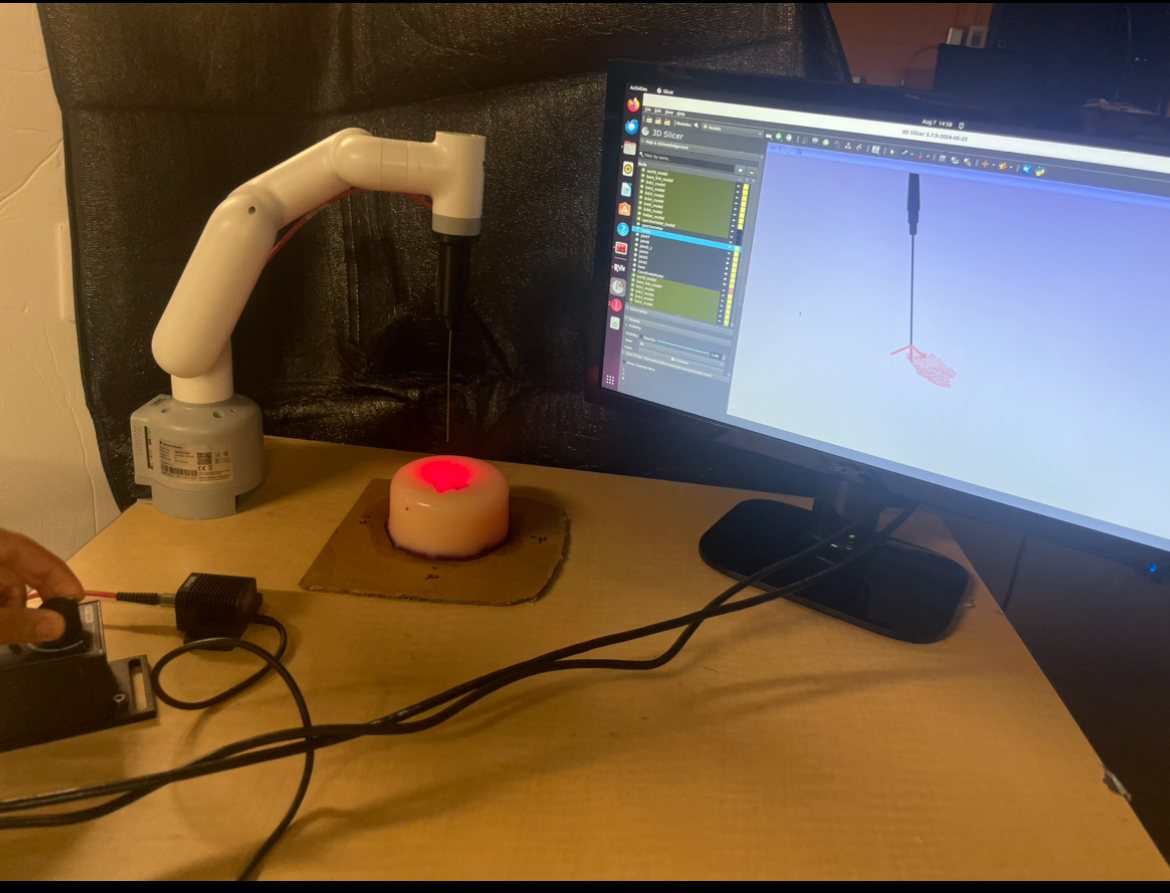
The two papers
An accessible 6-axis testbed for image-guided robotics research — first author. C. Farvolden, K. Hashtrudi-Zaad, L. Connolly, C. Barr, G. Fichtinger. A reusable 3D Slicer module for motion planning with an inexpensive arm, evaluated on a 16-point phantom. PDF
Robotic tracking of a resection cavity using a low-cost bench-top robotic arm and electromagnetics. K. Hashtrudi-Zaad, C. Farvolden, L. Connolly, C. Barr, G. Fichtinger. An electromagnetic sensor in a 3D-printed retractor lets the arm follow soft tissue across 36 test positions. PDF
02 — Ongoing
Micro-scale manipulation
Tumours are mechanically different from healthy tissue, and that shapes how cancer cells move. I'm building an open-source magnetic micromanipulation system to measure it.
3D-printable · fits any inverted microscope · maps 3D stiffness gradients in living cultures
Why it matters
Measuring stiffness at cell scale normally needs equipment most labs cannot justify buying. A cheap, reproducible instrument means labs without that budget can run the same experiments — and linking stiffness to cell behaviour should help explain how tumours form and spread.
03 — Ongoing
Applied AI
I work on AI that does useful work: agent systems, evaluation, and machine learning on real data.
What that includes
LLM agent systems and the evaluation harnesses that keep them honest; sequence models (LSTM and GRU) in PyTorch; and convolution kernels built from first principles to understand what a vision model is actually doing. No publications in this area yet — that is the next thing to change.
04 — Projects
Autonomous systems
Robots that find their own way. LifeBot is a ROS2 rover that maps a building with SLAM and delivers an AED on its own; the autonomous loader follows a course, scoops and sorts material from sensor cues.
05 — Projects
Medical devices & simulation
NeuroNeck is a sensing neck brace that gives first responders instant feedback while they practise immobilising a spinal injury. It won first place of 80 teams at the NextGen Medical Simulation Hackathon.
Method
How I work
- Baseline firstKnow what you are comparing against before building.
- Report the spreadA number without its variance is half a result.
- State the limitsSay plainly what the system cannot do.
- Publish itA method nobody can reproduce is not much of a method.